
Coherent and Coordinated?
Europe’s Visa Policy and Strategic Confusion

Eleven Schengen Area countries – Sweden, Czechia, Denmark, Estonia, Finland, Latvia, Lithuania, the Netherlands, Poland, as well as Iceland and Norway – have signed an appeal to the EU authorities calling for European visa policy toward Russian citizens to be made stricter, more coordinated, and more consistent.
Of course, Europe has every right to decide whom it admits to its territory, on what conditions, and on the basis of what security considerations. If European countries want to tighten the issuance of visas to Russian citizens, that is their sovereign right and their political decision.
In itself, however, restricting entry for citizens of a particular state precisely on the basis of citizenship is a legally and politically slippery issue. It inevitably raises questions of discrimination, collective responsibility, proportionality, and the grounds on which a person is treated as a threat not because of his or her actions, connections, or participation in supporting the regime, but simply because of a passport.
It would be one thing if the European Union, or individual European countries, were at war with Russia: then every citizen of a hostile state would automatically be viewed through the prism of military confrontation and the logic of wartime. During war, citizens of enemy states do not, as a rule, visit each other for holidays, study, leisure, or business as if nothing had happened.
But European countries are not at war with Russia. Moreover, they continue to maintain relations with it almost at the pre-war level, albeit with certain exceptions. Russia is waging war against Ukraine, threatening Europe, carrying out sabotage, cyberattacks, political interference, and blackmail; yet Europe itself continues to exist in a strange intermediate mode: not normal relations, but not a consistent rupture either; not recognition of Russia as an adversary in the full political sense, but also not readiness to treat it as an ordinary state. In this situation, visa restrictions based on citizenship become not part of a clear wartime logic, but a symptom of Europe’s broader uncertainty.
The eleven countries are quite right to write that the European response to Russian aggression must be coherent and coordinated. This is the right formula. More than that, it is precisely the formula Europe has catastrophically lacked since the very beginning of Russia’s full-scale war against Ukraine.
But if European policy really must be coherent and coordinated, why is this requirement applied so readily to the visa issue and with such astonishing hesitation to everything else? Why is a coherent and coordinated policy necessary when processing Schengen visa applications, but not when defining Europe’s goals in this war, matters of military assistance to Ukraine, the confiscation of Russian assets, the closing of sanctions loopholes, the protection of infrastructure, resistance to Russian agents of influence, and the development of a new architecture of European security? Why is coherent and coordinated policy immediately forgotten as soon as vague hints about “negotiations” once again come from Moscow – and European figures again and again launch into reflections on the territorial concessions Ukraine should supposedly make?
Let us reveal a small secret: coherence and coordination in politics do not begin with a visa application form. They begin with an answer to the question – what Europe actually wants to achieve.
Does Europe simply want to “stop the war” – that is, wait for the moment when the aggressor itself finds it useful to slow down the offensive temporarily in order to regain strength? Or does Europe want to “end the aggression” – that is, force the aggressor to stop military operations, withdraw its troops, give up what it has seized, and deprive it of the ability to repeat the same thing a few years later?
These are fundamentally different things. The aggressor can “stop” the aggression itself whenever it finds that convenient. Ending the aggression must be done by the opponents of the aggressor – through the force of their policy, military assistance, economic pressure, diplomatic isolation, and a clear strategic objective.
Europe still does not have such an objective – or, more precisely, it has never formulated it clearly, firmly, and publicly. How exactly should this war end from the point of view of European interests? What should the post-war order on the continent look like? How will the security of Ukraine and European countries be ensured? What measures will be taken to prevent a new aggression? What will Europe’s relations with Russia be?
Where is the comprehensive strategy in which visa policy would be one of the instruments – rather than a substitute for a strategic, coherent, and coordinated approach?
In normal politics, the objective is defined first; then the strategy is built; and only then are the instruments selected accordingly. In current European practice, the reverse happens: a convenient instrument is chosen – in this case, visas – a political posture is constructed around it, this is then presented as a display of firmness, and the question of the ultimate objective is postponed until later.
This is the classic case of searching not where something was lost, but where the light is better. Where it is possible quickly to tighten procedures, reduce the number of multiple-entry visas, and report on one’s principled stance, European policy suddenly becomes severe and clear. But where difficult decisions are needed – decisions capable of genuinely changing the course of the confrontation with the Putin regime – caveats, exceptions, legal complications, the “need for dialogue,” fear of escalation, and endless talk about how sooner or later everyone will have to sit down at the negotiating table immediately reappear.
This performative strictness looks especially absurd against the background of the fact that many representatives of the Russian regime, as well as members of their families, have long possessed European passports, residence permits, real estate, bank accounts, companies, and stable channels of movement across Europe. Others use Israeli passports or passports of other states that enjoy convenient entry arrangements with the EU. In other words, people embedded in the Putin system, who have benefited from its money, status, corruption opportunities, and political protection, often have far more reliable access to Europe than an ordinary Russian applicant for a Schengen visa.
Here, for some reason, European resolve becomes far less visible. Where is the systematic review of passports, residence permits, and investment schemes that have already been granted? Where is the verification of the origin of the capital used to buy real estate, obtain residency, and open companies? Where is the consistent work to strip representatives of the Putin elite and their families of the European privileges they continue to enjoy?
The same problem is in sanctions policy. European sanctions remain full of holes, inconsistent, and in many respects poorly thought through. Personal sanctions should have split the ruling regime, raised the price of loyalty to Putin, created incentives to exit the system, and demonstrated a distinction between those who continue to serve the regime and those who are prepared to break with it. In practice, however, they have so far failed to detach the beneficiaries of the Putin system from the Kremlin. On the contrary, they only drive these people deeper into the Putin structure, offering them neither a political exit, nor a comprehensible system of incentives, nor a clear mechanism for breaking with the regime.
This is not a strategy, but an administrative reaction. Not politics, but the bureaucratic processing of symptoms.
Ending the aggression means creating conditions under which its continuation becomes unacceptably costly for the Putin system, militarily impossible, economically destructive, and politically dangerous. It means helping Ukraine not “for as long as it takes” in some vague ritual sense, but as much and in such a way that it can liberate its territory and deprive Russia of the ability to continue the war. It means building European security not around fear of Putin’s defeat, but around the understanding that the preservation of his capacity for renewed aggression is precisely the main threat to Europe.
This is where a real coherent and coordinated policy is needed – not in consular departments and visa instructions, but in a comprehensive strategy that links military assistance to Ukraine, sanctions pressure, the confiscation of Russian assets, the fight against sanctions evasion, energy policy, counterintelligence, infrastructure protection, resistance to hybrid warfare, and the post-war settlement of Europe into one internally consistent political course.
In such a strategy, the visa issue would take its proper place – not central, not symbolic, but instrumental. Then it would be clear why particular restrictions are introduced, whom they are supposed to affect, and what political purpose they serve. Then it would be policy, not a gesture.
If European ministers seriously believe that the response to Russian aggression must be coherent and coordinated, they should begin not with visas, but with the formulation of a common objective. Russian aggression must not be “stopped” by yet another pause; it must be ended. Russia must be forced to withdraw its troops. Ukraine must be given the opportunity to restore its territorial integrity. Europe must build a security system in which a new Russian aggression becomes not merely undesirable, but practically unfeasible.
That would be a consistent policy.
Everything else is merely searching under the streetlight.
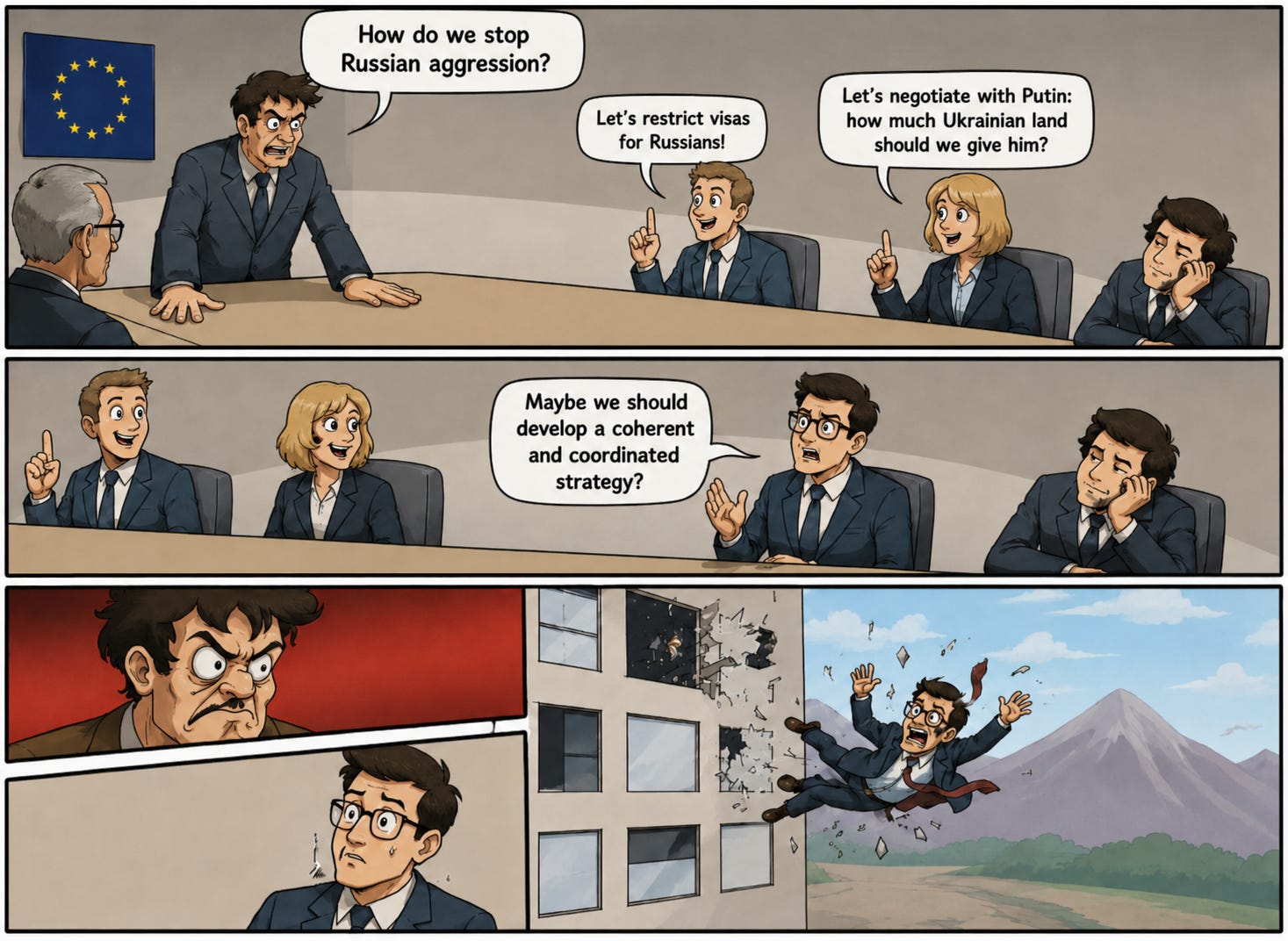
If I recall correctly, this is the first time the EU has been forced to develop a coherent foreign and security policy strategy—a strategy that will have long-term consequences for all member states.
Foreign and security policy has always been the prerogative of national governments; the appointment of a High Representative for Foreign Affairs has not changed that.
To begin with, it would suffice if Germany, France, the Scandinavian and Baltic states, and Poland took the lead. However, all these countries have different foreign policy traditions and capabilities.
Germany, for instance, lacks any strategic foreign policy competence, as evidenced by its disastrous policy toward Russia since 1998. The situation is different in France and Finland, as well as in Poland.
Diverging interests also play a role. France’s level of involvement differs from that of Estonia or Poland—to say nothing of Italy, Greece, and Portugal. This is a pivotal moment: either the EU comes of age, or it becomes a football for Russia, China, and the USA.
It's a learning process after all, isn't it.